>> APEX: Support / Microphones Explained

BASIC TYPES

There are two basics types of microphone commonly used in pro audio, "dynamic" and "condenser". A third type, the "ribbon" mic is sufficiently fragile that they seldom get used in live music sitiuations.

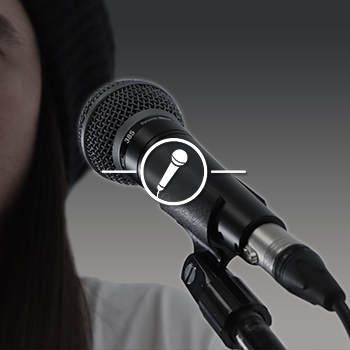
DYNAMIC MICROPHONES

The dynamic mic is most commonly found in PA applications due to its general ruggedness and simplicity of use (no need for phantom power or batteries). It works rather like a speaker in that there is a diaphragm attached to a coil of hair-thin insulated wire flexibly suspended in a magnetic field. Sound waves set the diaphragm and coil in motion vibrating back and forth which causes the coil to cut lines of magnetic force, thus a small amount of voltage is induced in the coil.

The voltage varies in polarity with the frequency of the sound waves and in strength with the amplitude or size of the waves (the louder the sound, the bigger the waves and the the farther the coil moves hence cutting more lines of magnetic force and generating more voltage). This voltage travels down the mic cable to the mixer where it is amplified and sent to the speaker.

For what it's worth, a speaker works exactly the same way only in reverse - it reacts to the amplified signal by vibrating back and forth to create sound. In fact, dynamic microphones and speakers are almost interchangeable. Believe it or not, you can connect a raw speaker, a woofer for example, to the line input on a mixer and hook the mic up to the amplifier outputs. Talk into the speaker and sound will come out of the mic. It won't work very well and you may promptly fry the mic, but this backwards PA will actually function (briefly).

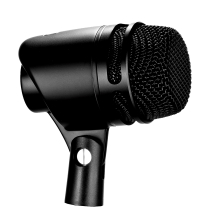
Dynamic mics are best for close-up use whether for vocals, instruments or instrument amplifiers. Certain models are also preferred for bass drum and others for brass instruments.

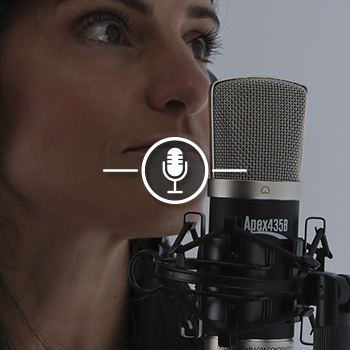
CONDENSER MICROPHONES

Condenser microphones offer high sensitivity and smooth frequency response. They operate on a small amount of DC voltage either from a built-in battery or a "phantom" power supply unit, or from the mixer if it has phantom power built in. This is deposited as positive and negative charges on two thin metal plates with a small airspace or other resistive material between them. This forms the diaphragm cartridge.

Sound waves cause the top plate to vibrate which alternately compresses and de-compresses the resistance. It acts as a dielectric and a signal voltage is produced that varies in polarity and amplitude with the frequency and amplitude of the sound waves. This travels down the cable to the mixer and is amplified. It is worth noting that the phantom voltage will not harm most dynamic microphones if they are connected to a mixer which has this feature built in - nor will the sound be affected.

Condenser mic technology is ideal for virtually all applications with the possible exception of bass drum. Certain models are designed to pick up sounds at a distance or groups of people, choirs for example. Other condenser mics are first choice for acoustic instruments, especially guitar, banjo, mandolin, violin, upright bass, piano or anything with strings. They are also preferred for overhead coverage of drum sets. At one time it was thought that condenser mics were too fragile for PA applications, however they have greatly improved over the years in that regard with many models now designed for this kind of work which virtually equal dynamic mics for road-worthyness.

PICKUP PATTERNS (a.k.a. "Directionality" or "Polar Response")

Most microphones are capable of picking up sounds approaching from a wide area, however they don't pick all of them up with equal sensitivity. The all-important midrange and high frequency sounds approaching from outside a mic's pickup pattern will be detected at far lower sound pressure levels those which are approaching from within the pattern and will get drowned out by them.

Pickup patterns can be imagined as invisible balloons, each with a particular shape depending on the microphone's design. These shapes are what you see listed as "polar patterns" in mic literature. Although the polar plot diagram is flat-looking, in reality mics pick up sounds coming from above and below as well as the front and sides and even the back. Hence polar patterns are 3-dimensional and really do resemble variously contorted balloons.

  • Uni-directional or "cardioid" mics can pick up a wide spectrum of frequencies over roughly a 120 to 150-degree sound field. Their polar pattern resembles the aforesaid balloon with the head of the mic pressed against one end. In practise this means that they tend to largely ignore sounds approaching from behind making them preferable for vocals and general PA use because they do not readilly feed back into stage monitors, provided the monitors are properly positioned.
  • "Hyper-cardioid" and "super-cardioid" mics are included in the uni-directional category and gererally offer a somewhat narrower sound field - or, to put it in more common terms, they exhibit more "directionality". Uni-directional mics may be dynamic or condenser-type.
  • "Omni-directional" mics accept a wide range of frequencies from virtually a 360-degree, spherical sound field. Their polar pattern resembles a balloon with the mic right in the center; in other words they pick up sounds from behind almost as loudly as from in front, above and below and the sides. As a result, omni-directional mics are less suitable for high-volume music applications and probably should not be used with monitor speakers at all. Omni-directional mics may be dynamic or condenser. Possible applications include recording round-table meetings or audience ambience.
  • The "boundary" or "plate" mic offers a 180-degree, "hemispherical" polar pattern, i.e. resembling a balloon which is flat on one side. It is designed to be attached to a flat surface which effectively bounces sounds from all over the field into the tiny mic's diaphragm. This flat surface can be anything from a sheet of plexiglass to a wall to the underside of a grand piano lid or the top of a desk.The boundary mic's best applications include grand piano, acoustic instrument groups, choirs, opera, stage plays and meetings. They are usually condenser-type.
  • "Shotgun" microphones have a very narrow sound field reflecting a "hyper-cardioid/lobar" polar pattern which usually resembles a small, horribly contorted balloon with the mic partly pushed into it. Unlike the others, these are always condenser mics using a long interference tube which cancels sounds from the sides. Shotguns are used to pinpoint distant sound sources and are principally found in the film and television industries. They seldom get used for music PA as they have to be aimed at the source which means someone has to hold and aim them. As a reult they may pick up monitors and thus feed back. However, there are PA applications for them where stage monitors do not get used as a rule including stage plays, also choir or chorale performances where soloists need amplification.
  • The "parabolic" mic, which is similar in terms of its applications, features a cardioid mic suspended in front of a plastic dish or parabola, aiming into the centre of it. Parabolic mics also must be aimed at the sound source, however they can be either dynamic or condenser-type and tend to be less expensive than shotguns. Both mics usually have variable directivity - their "pinpoint" factors. In shotgun mics with this feature it takes the form of a small control or switch. In parabolic mics you adjust the distance between the tip of the mic and the centre of the parabola. These microphones have been replaced to a degree in live theatre by miniature wireless mics which can be secreted in the costumes, but they are still required for film and TV applications and those stage shows where costumes are sparse.

High Or Low Impedance ( a.k.a. "Z")

Once upon a time, all PA mics were high impedance. This was because PA amplifiers of the day only had high Z inputs and were always situated close to the stage so that mic cable lengths seldom exceeded 20-odd feet. It wasn't until after "Woodstock" and the birth of concert PA technology that there was an increasing demand for mic cables long enough to warrant the need for low Z technology. Since then low Z has become the PA industry standard. High Z mics are now principally used with home entertainment equipment, short-wave and CB radios and commercial PA amplifiers as used in factories, hotels, hospitals, etc.

PLACEMENT

There are two variables to consider when placing a microphone relative to the sound source - distance and angle. Distance is the most important factor as it determines a variety of things including signal level, clarity, exclusivity (how many sound sources get picked up) and even bass reponse in some mics. Hand-held vocal mics, for example, should generally be kept around 5 inches from the mouth. On a crowded stage with the band playing very loudly, this distance may have to shrink to just an inch or two so that the mic will pick up a predominance of that performer's voice or instrument. At this distance however, certain mics produce a distinct increase in bass response due to proximity effect. Some vocalists prefer that sound even though it may be accompanied by "pops" and other sound effects including distortion.

  • TIP - If a microphone is creating "thumps" or "pops", turn down the low-frequency or bass control on that channel to reduce the problem. Some vocalists may like these noises, but audiences can find them irritating. Distortion is more difficult to cure with the mixer - try reducing the input Gain, Trim, Attenuation or Pad setting on that channel. If that doesn't work, try replacing the mic with one which has a little lower sensitivity. When you have a chance, try replacing the distorting mic's diaphragm - the old one may be fatigued.

Angle determines tone. Generally you will obtain the brightest tone with the mic aimed directly at the sound source. A softer, mellower tone can be achieved by angling the mic in relation to the source.

Here are a few standard microphone placement suggestions:

  • Lead vocals - See above paragraphs [Dynamic, Condenser or Cardioid]
  • Harmony vocals - Same as above for individual mics, slightly farther away and at roughly a 45-degree angle to their mouths if two singers are on the same mic [Dynamic, Condenser or Cardioid]
  • Acoustic guitar - Aim directly at the bridge, not the sound hole (too "boomy") and get as close as possible [Condenser, Cardioid]
  • Saxophone - Place the mic roughly 3 inches above the bell and angle it slightly [Dynamic, Cardioid].
  • Trumpet, trombone, etc. - Distance the mic a foot or so away to avoid overloading and aim directly at the bell [Dynamic, Cardioid].
  • Acoustic upright bass - At a distance of roughly 4 to 6 inches, aim directly at a point 1/2-way between the bridge and one of the F-holes [Condenser, Cardioid].
  • Guitar or bass amp - Place the mic close to the grill aiming directly at the centre of the speaker [Dynamic, Cardioid]
  • Keyboard amp - These usually have a 2-way speaker system which makes miking them complicated. You could aim two dynamic cardioids directly at the woofer and tweeter then adjust the two mixer channel levels for low and high frequency balance, but your best bet is to take a "line-level" output from the amp and run it directly into a Line input on the mixer.
  • Grand piano - Usually this is a job for two condenser cardioid mics placed inside, one pointing down at the middle of the bass string section above the hammers and the other over the high strings. Another approach is to affix a plate or boundary mic to the underside of the lid, somewhat closer to the high strings than the bass strings and above the hammers. In a rock band situation, keep the lid closed as much as possible and experiment with mic positioning (the pianist will have to hear himself through the monitors).
  • Bass drum - Close to the front drum head or preferably inside the drum [Dynamic, Cardioid]
  • Snare drum, ride cymbals, tenor and floor toms - As close as possible over the sources, aiming down at the tops. Wherever possible try to minimize the number of mics in use as each open mic reduces the system gain before feedback by 3dB. For example, try using one or two condenser mics over the tenor toms and ride cymbals plus one over the floor toms, one for the hi-hat cymbals and one for the snare. Five or six mics including the one for bass drum should suffice for most standard sets. [Condenser, Cardioid or Hyper-Cardioid]